South Korea Imposed Martial Law
Tuesday, December 3, 2024, at approximately 10:27 p.m. Korea Standard Time (KST), South Korea's President Yoon Suk-yeol declared martial law.
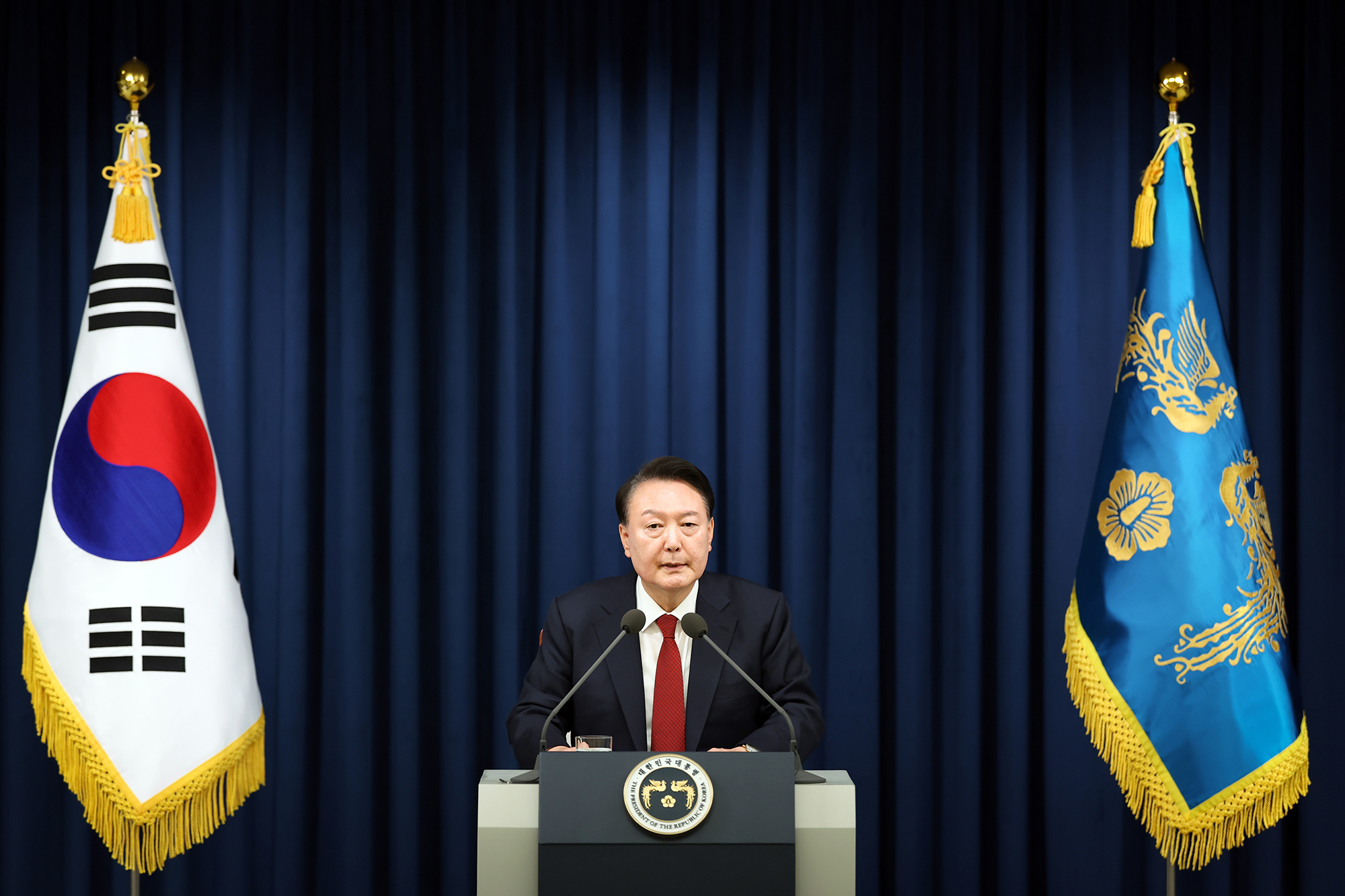
Martial law is a temporary measure where military authorities take control during emergencies, replacing civil authorities deemed unable to function or maintain order. This declaration is historically significant for South Korea, as the last martial law was declared in the 1980s.
South Korea operates as a presidential republic, where the president wields extensive powers, including appointing the prime minister and serving as the commander-in-chief of the armed forces. This political framework has enabled President Yoon to enact such measures in response to what he described as a constitutional crisis.
Background and Context
The martial law is imposed after the opposition democratic party cut the budge for 2025 by nearly 3 billion dollars, removing the fund for disaster response, social assitance, gas field development and delaying military salary. In response, President Yoon accused the opposition of undermining the nation’s constitutional order, stating:
"This trampling of the constitutional order of the free Republic of Korea and the disruption of legitimate state institutions established by the constitution and laws is an obvious anti-state act that plots insurrection... I declare emergency martial law to defend the free Republic of Korea from the threats of North Korean communist forces and to eradicate the shameless pro-North Korean anti-state forces that are plundering the freedom and happiness of our people and to protect the free constitutional order,"
He promised to stabilize the nation quickly, reassuring the public in his address:
"These measures are necessary; there is no change in our foreign policy stance... Please trust me."
Yoon justified the declaration under Article 77 of the Constitution, which allows martial law when military necessity or public order is at stake.
What Led to Martial Law?
Contrary to Yoon’s references to North Korean threats, the martial law declaration stems from internal events in the country. Yoon Suk-yeol, who won the 2022 presidential election as the candidate for the conservative People Power Party, has faced significant defeat in the 2024 parliamentary elections. His party only holds 108 out of 300 seats, while the Democratic Party secured a dominant 170 seats. This made him unable to push through his laws and led him to use his presidential veto power to block the bills proposed by the opposition. However, veto power does not apply to budget approvals, leaving Yoon unable to reverse the opposition's cuts.
Adding to his challenges, Yoon’s administration has been plagued by scandals, including allegations against his wife involving corruption and influence-peddling. These issues have further eroded his support, both domestically and within the National Assembly.
This decree has led to significant backlash, including criticism from the opposition and the public. The opposition leader of the Democratic Party, Lee Jae-myung, stated that Yoon's actions are unconstitutional and illegal. He called on all party members to gather at the National Assembly. Even Yoon's own party leader, Han Dong-hoon of the People Power Party, criticized the decision.
Military takes action
South Korea’s military commanders held a meeting at the Ministry of Defense, where they ordered the police and military to prepare for emergencies.
General Park An-su, the Army Chief of Staff and the new commander of martial law, announced strict rules. He suspended the work of the National Assembly and banned all political activities.
"All political activities, including those of the National Assembly, local councils, political parties, associations, rallies, and demonstrations, are prohibited," General Park said.
He also said any actions against the democratic system, spreading fake news, or false information would not be allowed. Additionally, all media and publications will now be controlled by the Martial Law Command to prevent misinformation.
People who break the rules face the risk of being arrested, searched, or detained without a warrant. The decree states that the military will try to avoid causing problems for ordinary citizens, except for those "trying to overthrow the government." The Ministry of Defense has also told reserve soldiers to be ready to report for duty.
Online, photos and videos show military machine on the streets of Seoul, with combat helicopters flying over the city. Witnesses report seeing several convoys of military vehicles heading toward the parliament building.
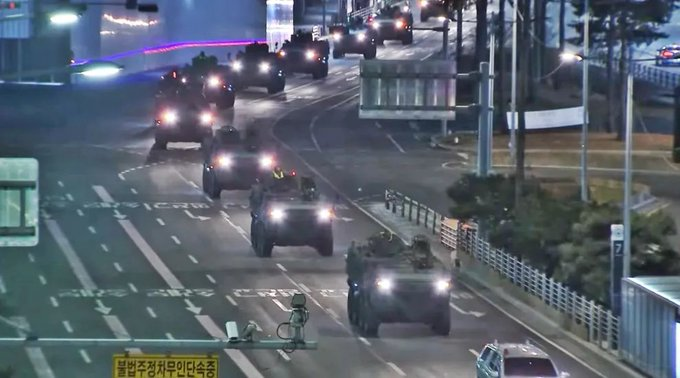
Protesters and opposition lawmakers reportedly tried to enter the National Assembly but were stopped by security forces following the president’s orders.
Martial Law Lifted
Despite the presence of security forces, the National Assembly voted unanimously to cancel martial law, with all 190 members supporting the resolution. According to the Speaker's office, this decision rendered President Yoon's decree invalid. Under Article 77 of the Constitution, if the majority of registered parliament members approve the cancellation of martial law, the president is constitutionally required to comply. Local media reported that once the resolution passed, the military began withdrawing from the parliament building.
Updates
Below are updates on the aftermath of the martial law being lifted.
7 Dec 2024
- President Yoon issued a statement apologizing for imposing martial law, describing it as a decision made out of desperation.
“I am very sorry and would like to sincerely apologize to the people who were shocked,” Yoon said, promising there would be no second attempt.
“I leave it up to my party to take steps to stabilize the political situation in the future, including the issue of my term in office,” he said, standing in front of the South Korean flag and bowing at the end of his remarks. - Despite his apology, Yoon refused to resign, even as pressure mounted for him to step down.
- Han Dong-hoon, leader of Yoon’s People Power Party (PPP), stated that Yoon was no longer in a position to fulfill his duties and that his resignation was inevitable. Han added that Yoon posed a danger to the country and must be removed from power.
- The opposition party announced plans to hold a vote to impeach Yoon. If the initial vote fails, they intend to conduct another vote.
- South Korea’s economy took a significant hit, with the won plummeting against the US dollar following the imposition of martial law.
Sources
- South Korea declares martial law – What's happening and reason | RBC-Ukraine
- Materials from South Korean agencies Yonhap and Chosun, as well as Western agencies Associated Press, Bloomberg, and CNN
- S Korea’s Yoon apologises for martial law crisis as impeachment vote looms | Politics News | Al Jazeera